
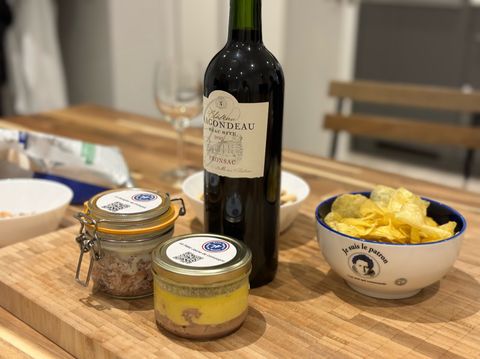
Pâté, cooked in a terrine or canned in a jar, is one of the great home-charcuterie preparations, and this guide takes it from first principles to the finished jar. There are other related categories (rillettes, mousses, pressés, pâté en croûte). Pâté en croûte, a preparation in its own right, will get its own guide, and so will foie gras, a world of its own.
In this guide, pâté refers to the charcuterie preparation itself. Terrine refers to the cooking vessel, or by extension a pâté cooked in one. In practice the two terms are often used interchangeably, and the same product may be called pâté de campagne or terrine de campagne depending on the context.
Part 1 · The theory
How a pâté is built, from the five families of ingredients to the method that turns them into a bound mêlée.
The five families & the six steps
Almost any pâté recipe can be broken down into five families of ingredients:
- the meats
- the aromatic garnish
- the seasoning
- the alcohol
- the binder
Once the ingredients are chosen, the method almost always follows the same broad steps:
- salting the meats (mise au sel)
- preparing the aromatic garnish
- grinding and building the mêlée (the meat mixture)
- binding
- cooking
- resting and maturing
The meats
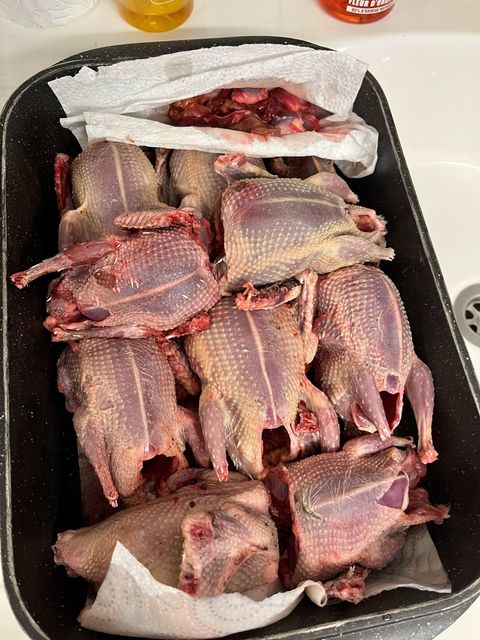
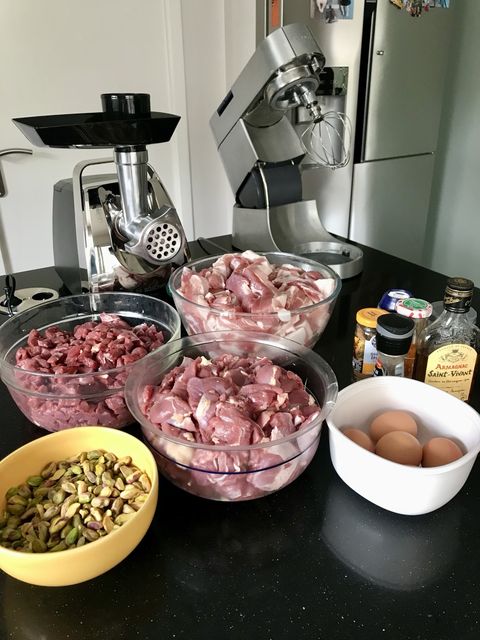
The meats are the identity of a pâté. They set its main flavour, but also its texture, its juiciness and how well it holds together. Practically every recipe can be read through four fundamental proportions.
Lean
- The lean is the muscle.
- It brings the main meat flavour, the colour and the structure of the pâté.
- The higher the proportion of lean, the more the featured meat (rabbit, pheasant, wild boar, venison…) comes forward.
Fat
- Fat is responsible for the indulgence.
- It brings unctuousness, the sensation of juiciness, richness on the palate and better keeping.
- A pâté too low in fat is usually dry and crumbly.
- Too much fat, conversely, gives a heavy texture and a pâté that melts poorly in the mouth.
Collagen
- Collagen comes mainly from connective tissue: pork jowl (gorge), belly, rind (couenne), tendons and parts of the shoulder.
- During cooking, some of the collagen turns to gelatine.
- It brings better-holding slices, a more tender texture, better juice retention and fewer holes in the slice.
- Collagen does not replace fat. The two play very different roles.
Liver
- The liver is probably the ingredient that gives a pâté its identity.
- It brings aromatic depth, a slight bitterness and the flavour characteristic of French pâtés.
- The more you add, the more assertive the pâté becomes.
- In small amounts it simply supports the other meats. In large amounts it becomes the dominant aroma.
What to do with the leftover carcass
- Simmer the trimmings in water with aromatics (thyme, bay, carrots, onions, garlic, white wine).
- Strain through a chinois, then reduce the stock to concentrate and clarify it.
- Use it as a base for sauces, or to moisten a farce.
- It freezes well. Freeze it in cubes for easy use later.
- Go easy on the salt.
A full, near-scientific comparison of French vs. American meat (cuts, labelling and fat content) is coming soon.
As a rough tendency (not a rule, since every charcutier has their own balance):
- Pâté / terrine de campagne → heavier on fat and liver.
- Meat pâtés (wild boar, rabbit…) → heavier on the featured meat.
Two broad approaches
Most French pâté recipes simplify into two families.
Country pâtés (de campagne) tend to favour more fat, more liver and a rustic texture. Their flavour is rich and strongly typed.
Game or meat pâtés aim instead to showcase one particular meat: rabbit, pheasant, wild boar, venison or hare. The proportion of lean is therefore higher, while fat and liver mainly serve to balance the whole.
A useful principle: the more delicate the meat, the less liver. As the meat gets milder, the liver is dialled back so as not to mask its aroma, often following a progression like wild boar → pheasant → rabbit → chicken (most liver to least). Wild boar easily carries a high proportion of liver; a chicken pâté generally has very little, sometimes none at all in modern recipes. Don't confuse this with a poultry mousse (chicken, duck…), which by definition is an emulsion built on offal.
The aromatic garnish
The aromatic garnish is everything that rounds out the meat without being the main event. Its job is to add complexity, freshness or contrast.
Aromatics
Background flavours: onions, shallots, garlic. Usually cooked before they go in, to develop their natural sugars, soften their taste and drive off some of their water.
Herbs
Freshness, and part of the recipe's identity. Most often thyme, parsley and bay.
Mushrooms
Woody notes, umami and a more tender texture. Usually pan-fried first to drive off excess water. Dried mushrooms work too: rehydrated or ground to a powder they concentrate the aroma and can absorb some of the mêlée's moisture.
Nuts & dried fruit
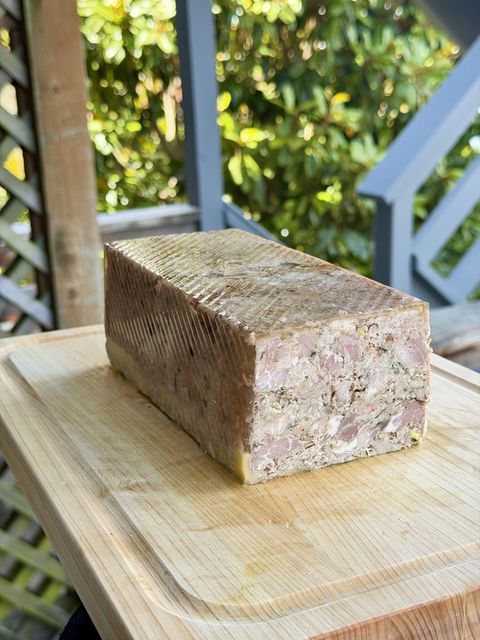
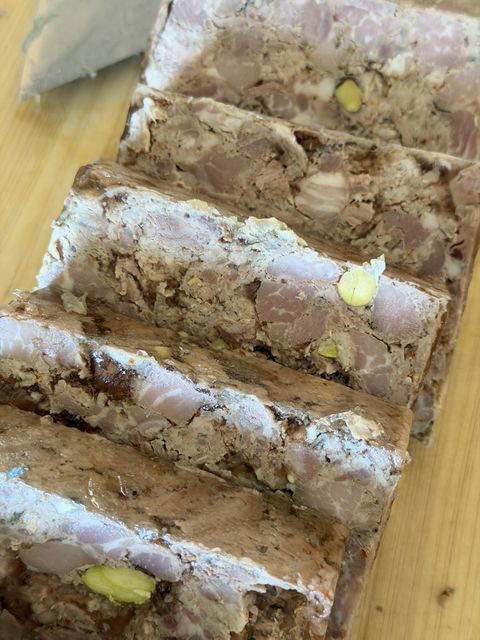
Not there to flavour so much as to create textural contrast: pistachios, hazelnuts, walnuts, chestnuts. They add crunch and make each slice more interesting to eat and to look at (the marbrage, or marbling).
Luxury ingredients
Foie gras, smoked duck breast (magret fumé), truffle, morels, candied fruit. They create marbling or inclusions that give the pâté a more festive character (Christmas and the like).
Seasoning, alcohol & the binder
Seasoning
Salt and pepper matter most.
- Salt: 12–18 g per kilo of meat, adjusted for the saltiness of the other ingredients. More salt keeps better.
- Pepper: 3–5 g per kilo of meat. You can swap 1–2 g for piment d'Espelette if you have it. It's more aromatic than black pepper and a good complement, though not a replacement.
- Other spices often seen: quatre-épices, nutmeg, cloves, juniper (for game).
The goal is usually not for the pâté to taste of spice, but for the spice to quietly support the meat.
Alcohol
Alcohol is an aromatic signature of many French pâtés. It should go in during the mise au sel so it perfumes the meat and survives cooking. You still want to sense it in the finished product.
The usual choices: cognac or armagnac, calvados, port, Madeira, white or red wine. For example:
- Armagnac: country pâtés, pork, duck.
- Cognac: classic recipes.
- Calvados: pork, poultry, apples.
- Port: liver, poultry, game.
- Red wine: wild boar, venison, hare.
Don't overdo it. Alcohol can take over the flavour of the meat.
The binder
You can add one whole egg per kilo of mêlée, though it isn't obligatory. Some recipes use liquid cream, which also helps bind. It's the coagulation of these ingredients during cooking that does the binding. Their effect on the final flavour is slight but not negligible, so dose them carefully.
Some rustic recipes also use bread or flour to bind and hold the juices, but that's rare in more refined recipes.
In practice
Recipes often call for expensive or hard-to-find ingredients. But the original philosophy of the pâté is to make something out of the livers, fat and meat that are left over.
Personally, if I have access to a rare meat I'd rather cook it another way. I like making pâté when I have too much of a less noble meat to use up, and in that case you don't always have every ingredient to hand. As we've seen, it's enough to:
- aim for roughly 30% fat / 70% lean, topping up what's missing with cuts that are easy to buy
- put together an aromatic garnish that's also easy to source (garlic, onions, bouquet garni, cloves…)
- marinate the meats in an alcohol (cognac, armagnac, port or red wine) depending on the meat and the recipe
- treat piment d'Espelette as belonging to the pepper family, replaceable by black pepper
The method, step by step
Salting the meats (mise au sel)
The first step, and often the most important for the flavour of the finished product, is the mise au sel: preparing the meat so the seasoning penetrates the flesh. The meat is cut into pieces or strips, not ground, mixed with the seasoning (salt, pepper, spices) and the alcohol, then rested in the fridge for 8–24 hours, a whole night (~12 h), say. You can go shorter or longer as circumstances allow. Too short and the seasoning is less even. Very long can give a firmer texture and more pronounced aromas, especially with spices or alcohol. Piece size matters too: the smaller the cut, the faster it marinates, and the larger, the slower. At this stage, follow the recipe and trust the author's experience. It's generally best not to marinate already-ground meat. That gives better texture control, less oxidation, less microbiological risk and less loss of juices.
A note on watery meat (an optional preliminary)
Some lower-quality meats (often from big-box or budget supermarkets) hold a great deal of water. That excess moisture makes a pâté that shrinks a lot in cooking, looks less appealing, tastes blander and eats dry. For these meats it's well worth preparing them even further ahead. For example, dry the cut pieces on a rack in the fridge for a day, ideally salted (respect the recipe's salt proportions) to help draw out the excess water, or wrapped in paper towel. This maturing step is rarely mentioned in recipes, but for the home cook who doesn't always have access to good meat it's extremely important. Do the mise au sel after this optional preliminary step.
Preparing the aromatic garnish
After the mise au sel, prepare the aromatic garnish, usually cooked, for a few reasons: to avoid it being under-cooked in the finished product, to remove excess moisture, and to add flavour through the caramelised juices (sucs). Onions, garlic, mushrooms and herbs (thyme, parsley) are gently sweated in a pan with butter, then set aside separately until the next step. The sucs can be recovered by deglazing (careful not to add too much moisture, and reduce it if needed). Some recipes lightly cook certain cuts such as the livers, again to push their flavour forward via the sucs. Raw liver gives a milder taste, while just-seared liver gives more character. More refined, already-prepared ingredients such as candied fruit and vegetables or nuts are generally added as-is. For watery meats and recipes that include mushrooms, it can help to add the mushrooms dried, where they act as a sponge to capture the excess moisture.
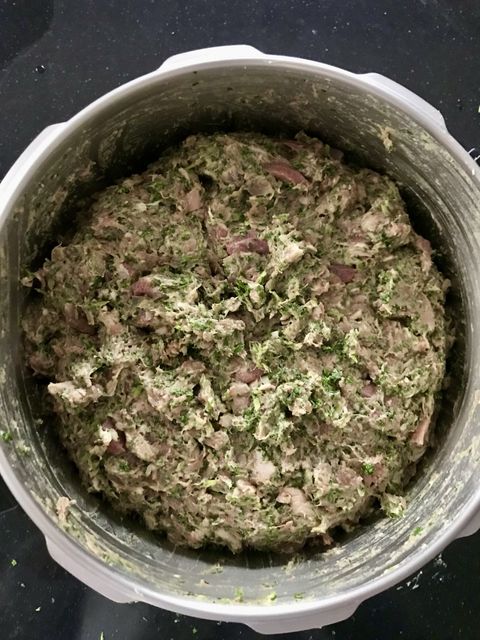
Grinding and the mêlée
Now the central step: the grinding. Take all the meats (lean, fat, livers) out of the mise au sel and pass them through a grinder fitted with the coarsest plate you can. Too fine a plate gives a dense farce that's less interesting in the mouth. Some recipes suggest holding back a third of the noblest pieces (typically the lean of a special meat) and dicing them by hand into 0.5 cm cubes. Added to the ground farce, they create a lovely textural contrast and a beautiful marbrage, clearly visible when a terrine is cooked and sliced. While grinding, alternate the pieces in the feed tube (a piece of lean, then fat, then liver, repeat), which naturally pre-mixes the meats. Add the hand-cut cubes to the ground mass, then add the aromatic garnish and mix. Depending on the recipe, some of the garnish can be passed through the grinder too. The result is the mêlée. Tip: grinders often trap some meat inside the tube between the throat and the plate. Push it through with something like a piece of bread, and stop grinding when the bread starts to reach the plate.
Binding the mêlée
The last step before cooking is to bind the mêlée. This matters for a homogeneous texture with a bit of "strength" (as you'd say in pastry). It clings to the hand, is slightly elastic and no longer crumbles. We say the mêlée is bound, or that it "strings" (elle file). Good binding does a lot for the final texture. Slices are less crumbly, easier to cut, with fewer holes and better moisture retention. To get there, first mix it mechanically and well. Grinding and cutting the meat exposes the soluble proteins (mainly myosin), which drive the binding. Depending on quantity, use a spatula or the paddle of a stand mixer. Then, if you like, add a binder as described above, usually egg and/or cream, though it's optional. Mixing the meat well remains the most effective technique.
Ready to cook
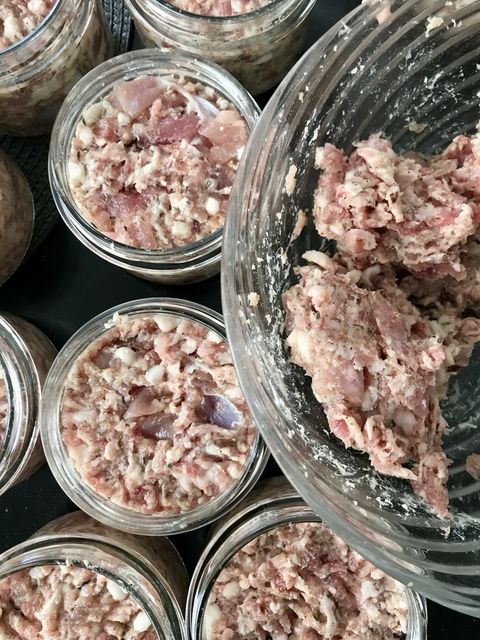
At this point the mêlée is ready. It's worth pan-frying a little of it to check the seasoning (salt, pepper and other spices) and adjust cautiously. The mêlée keeps up to about 24 hours in the fridge as-is, but no longer, for microbiological safety. It can, however, be frozen (ideally vacuum-sealed) to cook later.
Part 2 · Cooking & conservation
This part covers the cooking and conservation of pâtés and terrines.
Plenty of other categories aren't covered here: mousses, pressés, en croûte and foie gras.
Cooking methods & containers
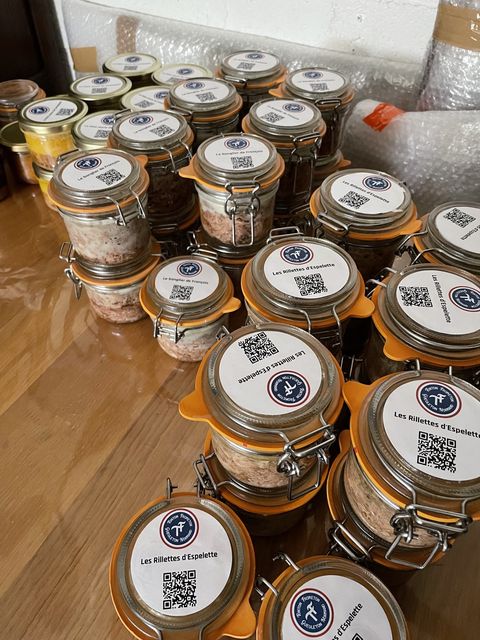
- Pâtés can be cooked in a terrine (a terrine mould or a cake tin) or directly in a jar for preservation.
- Pâtés can also be cooked en croûte (in a pastry crust). Since pâté en croûte is a preparation in its own right, it gets a dedicated guide.
Cooking in a jar (mise en bocal)
Canning in jars preserves pâté for the long term, but it is a food-safety exercise, so take every step seriously.
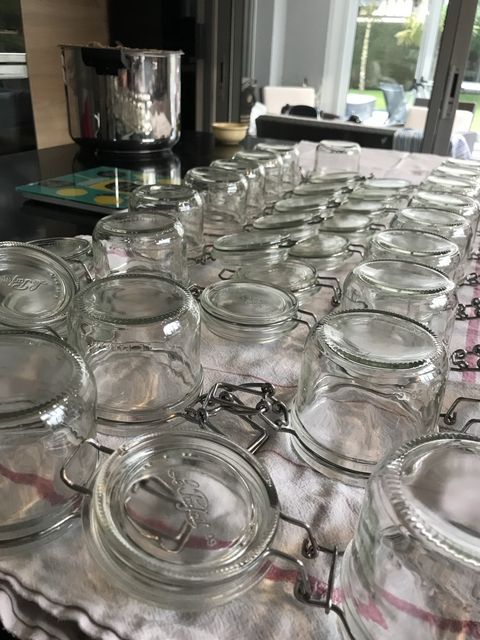
- Sterilise the jars: boil the jar + gasket + lid for at least 10 min, then dry them upside-down on a spotless towel or a rack.
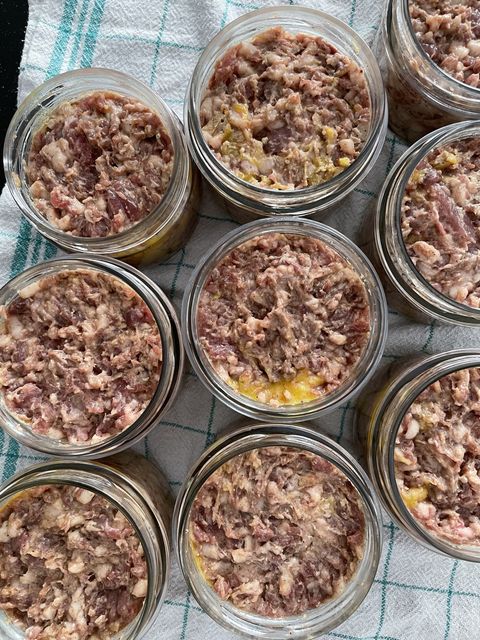
- Fill precisely, packing the mixture down so there are no air pockets. A piping bag helps, and so does a funnel.
- Keep the rim, gasket and threads spotless. Any residue risks an air gap, or a smear of meat that spoils on contact with air.
- Leave the headspace the recipe or jar calls for (usually 1–2 cm for terrines and pâtés). Too full and it pushes out the top during cooking and fails to seal.
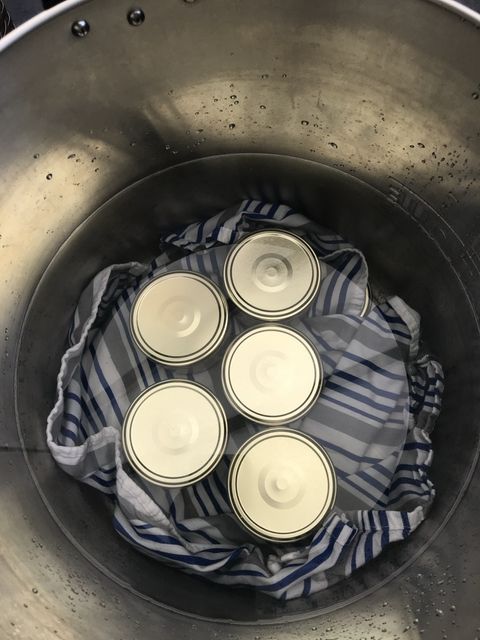
- The jars must be fully submerged for the entire cook.
- At home, use a large pot of water.
- Lay towels on the bottom and between the jars (do this while cold).
- Start from cold. Heating from cold avoids the thermal shock that can crack or burst jars.
- Start timing only once the water reaches temperature.
- Times (for ~500 mL jars):
- Pâtés (raw meat): 3 h at 100 °C.
- Let the jars cool in the water, and take them out once it's no longer hot. Use jar tongs, otherwise you risk dropping and breaking them (and burns if the water is hot).
- Check the seal:
- Gasket jars: the gasket should be hard to pull off (proof the air was driven out), with no grease leaking around it.
- Screw-lid jars: listen for the "clac" on opening, and the lid should have been concave beforehand (lower pressure inside).
- Label every jar to track the shelf life. A QR code can hold the expiration date and the ingredients.
- Never eat a jar showing a bulging lid, a leak, an off smell, unexplained bubbles, or mould.
- Limitation: jar cooking can't control internal temperature, so reserve it for pâtés whose meats and recipe aren't delicate. Use other methods for exceptional meats or sensitive ingredients, especially foie gras, which is very prone to overcooking. A terrine cooked with a probe gives a far more even texture than direct canning.
- For long ambient storage, the safest method is pressure canning (an autoclave or suitable pressure cooker, ~121 °C). Prolonged cooking at 100 °C is the traditional method but does not offer the same microbiological guarantee. Commercial meat conserves use an autoclave at ~121 °C under pressure precisely to reach true commercial sterility.
Cooking in a terrine (bain-marie)
- Preheat the oven, usually 140–160 °C depending on the recipe.
- Fill the terrine, tamping lightly to avoid air pockets (a cake tin works too). Smooth the surface and, if you like, cover with crépine (caul fat), then cover with a lid or foil.
- Set the terrine in a bain-marie: the hot water should reach about half to two-thirds up the sides.
- The water bath gives a gentle, even, uniform cook. The water never exceeds 100 °C, so even with the oven at 160 °C the heat reaching the terrine is much softer.
- Too-hot cooking can melt out too much fat, "split" a fine farce or mousseline, and dry the meat out.
- Water around the sides diffuses heat far more evenly than oven air, limiting the gap between the edges and the centre.
- Find a dish that holds the terrine plus enough water to reach halfway. Preheat the water (a kettle) and ideally the dish (leave it in the oven during preheat) to avoid thermal shock and cracks, and to shorten the cook.
- Cook to a target core temperature, measured with a probe. This is the most reliable criterion, far more than time.
- For most meat pâtés and terrines, aim for a core of 68–72 °C.
- Leave a cable probe in throughout, ideally with an alarm, positioned in the centre of the terrine.
- Don't trust the recipe's cooking time (it depends on the oven, the mould, the bain-marie). Go by core temperature.
- Press it back into shape while still warm. Out of the oven the meat will have compressed, and the juices are drawn out of the flesh, leaving gaps along the sides filled with cooking juices and fat. While it's still warm and flexible, press the meat down (with a glass, for example) to remould it throughout the terrine so it fills the mould evenly.
- Let it cool at room temperature, closer to an hour, until it's cool enough to refrigerate safely.
- Cool completely, then mature 24–48 hours in the fridge before eating. The flavour and texture improve markedly after this rest.
Storage
- Pâté in a terrine: 3–5 days in the fridge (up to a week if the recipe, hygiene and storage are optimal).
- Pâté in a jar: several months, up to a year, if the canning was done correctly and the jars are kept somewhere cool, dry and dark.
- Fat helps: the more fat, the better it generally keeps, since a good fat cap limits exposure to oxygen. But the fat itself isn't what guarantees preservation: that's the heat treatment, the vacuum, and the salt.
- Freezing: pâtés freeze very well after cooking (in a jar or vacuum-sealed). Thaw in the fridge.
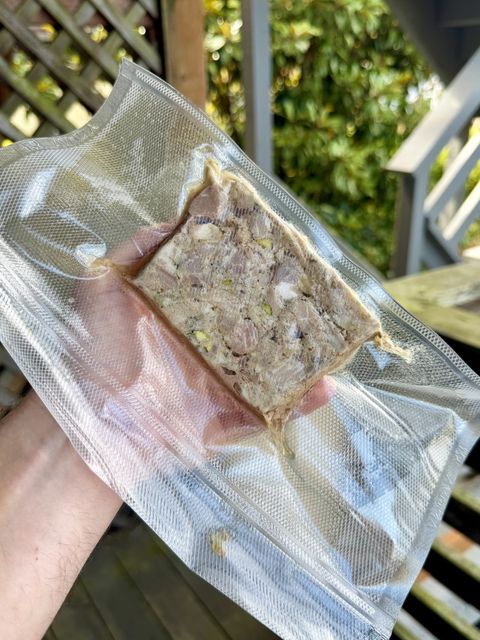
These durations come from my own amateur experience and are indicative only. They assume a preparation made under good hygiene and storage conditions. Never eat anything you are unsure about.
Serving
In France, pâté is most often served as a starter or with the apéritif. It's rich, so it's paired with something sharp: cornichons, sometimes mustard, and sometimes a green salad, all with very good fresh bread (sliced baguette or boule). In rough order of importance: bread, cornichon, mustard, green salad. An onion jam, a chutney or pickled onions can also be offered, but that's more a modern or gastronomic presentation than a classic charcuterie tradition.