
Tartine Bread
One-loaf Tartine-style country sourdough, mixed by hand and baked in a Dutch oven
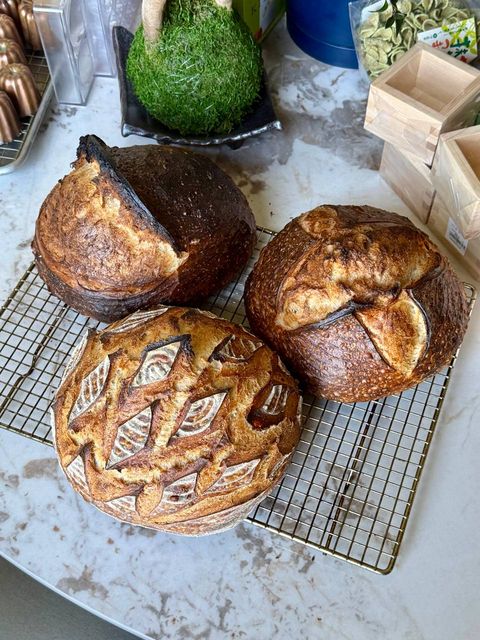
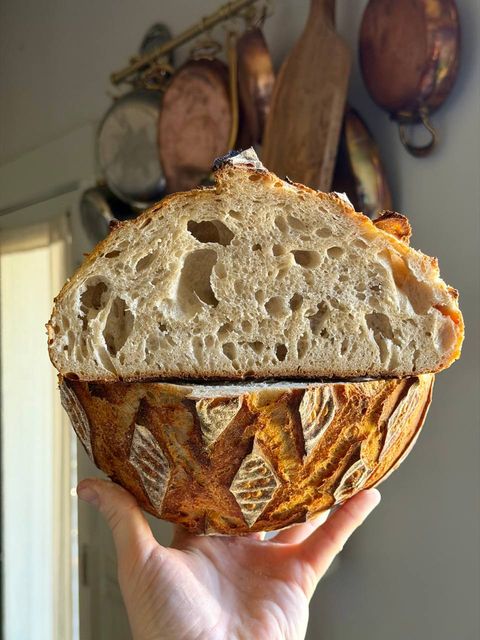
One loaf
- 100 g levain
- 450 g bread flour
- 50 g whole wheat flour
- 350 g water
- 25 g water, held back with the salt
- 10 g salt
A one-loaf Tartine-style country bread: 100 g levain, 500 g flour total, 75% water including the reserved water, and a Dutch-oven bake. The schedule is simple: mix, autolyse, add salt, fold every 30 minutes through bulk fermentation, shape, proof, then bake hot with steam.
Method
Mixing & autolyse
- Mix the water and levain first, then add the bread flour and whole wheat flour.
- Mix until no dry flour remains.
- Keep the salt and the reserved 25 g water aside for later.
- Cover with a lid or towel and autolyse for 25–40 minutes.
Post-autolyse
- Add the salt and reserved water together.
- Squeeze the dough between your fingers to incorporate the salt water.
- Fold the dough over itself until it feels cohesive again.
- Transfer the dough to a clear container with a lid.
- Keep it warm if possible, around 78–82°F; an off oven can work as a warm spot.
Bulk fermentation
- Bulk fermentation should take about 3–4 hours total.
- One turn means four stretch-and-folds: stretch one side of the dough up, fold it over itself, rotate the container, and repeat until all four sides have been folded.
- Do one turn every 30 minutes.
- Suggested schedule: 00:30 first turn, 01:00 second turn, 01:30 third turn, 02:00 fourth turn, 02:30 fifth turn, 03:00 sixth turn.
- The dough should rise by 20–30%. If it has not, continue a little longer with gentler folds.
- It should usually be ready within 4 hours total.
Shaping
- Initial shaping: shape the dough into a boule with a bench knife and your hands, creating maximum surface tension with as few moves as possible.
- Cover and bench rest for 20–30 minutes.
- Final shaping: fold the dough into its final boule, building tension without tearing it.
- Dust the proofing basket with rice flour, or a 50/50 mixture of rice flour and wheat flour.
- Transfer the dough to the basket seam-side up and cover.
Final rise
- For same-day bread, let the loaf rise for 3–4 hours at about 78°F.
- For next-day bread, cold ferment for 10–12 hours in the fridge.
Baking
- Preheat the oven to 500–550°F with the Dutch oven inside from the beginning.
- The key is to reach about 450°F as the baking temperature inside the Dutch oven; adjust the oven setting based on its actual internal temperature.
- Flip the basket and place the dough seam-side down on parchment paper.
- Dust the dough with a whole-wheat/rice-flour mixture.
- Score the dough to allow expansion. Do not wait too long after scoring.
- Carefully transfer the dough into the Dutch oven, add 2–4 ice cubes on the sides, put the lid on immediately, and transfer to the oven.
- Reduce the oven temperature to 500°F to keep the Dutch oven above 450°F, and bake covered for 20 minutes.
- Carefully remove the lid, watching for steam, and bake uncovered for 20–25 minutes, or until the crust is rich golden brown.
- A longer bake of 500°F for 25 minutes, then 475°F for about 15 minutes, also works well for deeper colour.
Cooling
- Transfer the bread to a wire rack and cool for at least 1 hour, ideally until completely cold.
- The bottom of the loaf should sound hollow when tapped.
Background
The dough starts with a short autolyse before salt is added. This gives the flour time to hydrate and makes the dough easier to strengthen by hand.
Warm bulk fermentation is important. Around 78–82°F, the dough should rise 20–30% within 3–4 hours while gaining strength from the repeated folds.
The Dutch oven supplies steam during the covered bake. The ice cubes help keep the crust flexible for oven spring, then the uncovered bake builds the dark, crisp crust.
Mistakes I've Made
- Leaving dry flour during the first mix. Mix until the flour is fully hydrated before the autolyse; dry pockets are harder to fix later.
- Adding salt too early. Hold the salt and 25 g water back until after the autolyse, then squeeze them in thoroughly.
- Folding too aggressively late in bulk. If the dough has not risen enough after the scheduled turns, continue gently rather than degassing it.
- Waiting too long after scoring. Score and load the loaf quickly so it does not spread before reaching the hot Dutch oven.
- Slicing too soon. Let the loaf cool for at least an hour, ideally until completely cold, so the crumb finishes setting.
Sources
- Tartine Bread —